
Precision, Memory, and Reinvention: Randa Mulford on Art After a Technical Career
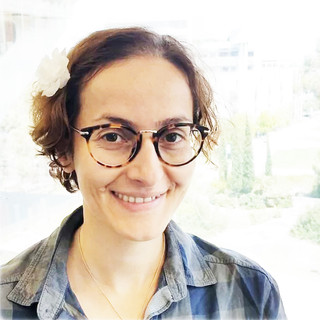
Updated: Mar 11

Introduction: Based in Mountain View, Randa Mulford channels her former career as a technical writer into a meticulous and vibrant textile art practice. She works across art quilt techniques—from geometric art quilts and recycled-material paperpiecing to intricate portraits derived from personal photography—blending structure with storytelling.
For Randa, art is a way to reorganize memory and geometry into something tangible. Whether she is constructing complex forms using rescued silks from FabMo or reinterpreting travel photos from Iceland and Chile, her work demonstrates that retirement is not a winding down, but a dynamic era of new construction and precise creativity.
“...I seldom begin a piece as an expression of a concept or emotion, but rather because I’m captivated by a picture or a technical challenge.”
Figure. 2. Snowfall. In this piece, Randa explores the "technical challenge" of repeating fractals, turning individual fabric shards into a cohesive and meticulously balanced winter landscape.
The Transition → Turning Point to Art
Leila (PEOPLE AROUND US): What made you start making art?
Randa: I’ve always created, that is, made art and/or craft. I was painting and drawing even before I started school, although in later years my creative energies were channeled more into more practical craft, such as sewing clothing and household items and making gifts (crocheted, knitted, embroidered, etc.) Sometimes I used a pre-existing pattern and made it my own in some way; other times I designed my own project.
Leila: Do you remember the moment when art shifted from “something I enjoy” to “something I need to do” in your life after retirement?
Randa: This shift happened long before I retired. Pretty much as far back as I can remember (maybe around age 12 or 13), I needed to have a handwork project going, something to occupy my hands while listening to the radio or television or going on a trip (car, train, plane). A born multi-tasker, I guess. I made my first quilt by hand-piecing the blocks during long, boring work meetings. After retirement I just had more time to make the creative work a focus of my day-to-day activities, not just something to fit in after the workday.
Leila: What was hardest about starting art without formal training?
Randa: As I said, I think I’ve always done creative projects, but I was a long time in recognizing or accepting that what I do with my quilt making could (sometimes) be considered “art”. To me, it’s always been craft. I still don’t consider myself a “real” artist in that I seldom begin a piece as an expression of a concept or emotion, but rather because I’m captivated by a picture or a technical challenge.
I’ve taken a lot of workshops from other quilt artists and always appreciate learning new techniques and new ways of looking at things. Over the years I’ve become very good at learning to use techniques that I’ve learned from others in my creative processes, to the extent that my work has sometimes been taken to be by one of my teachers. I’ve not been as successful in developing a style or voice that’s recognizably my own, perhaps because I enjoy trying lots of different things so much.
Figure. 3. From left to right: Winnie , Amelia & Drew, The Art of the Portrait – Randa’s collage quilts translate personal photography into textile art. From the expressive textures of a beloved pet to the high-contrast portraits of a couple, these pieces showcase her ability to capture character through fabric.
Leila: Randa, you’ve hit on such an important point. In the art world and some grad school programs, there is often pressure to have one "recognizable style," but your journey suggests a different kind of mastery—what I call multi-directionality. It’s so refreshing to hear you embrace that; it’s really art for art’s sake. For "born multitaskers," the joy is found in the doing and the technical challenge rather than a fixed "artistic voice."
It seems the fuel for your work is that constant curiosity and the restless energy to keep your hands busy. That curiosity is a style in itself.
Precision and Visual Language
Leila: Randa your work shows remarkable precision. Do you think your technical writing background influenced that?
Randa: I think precision and attention to detail have always been part of my personality. A natural born editor! One of my creative challenges has been to try some less structured approaches to art quilts, such as improvisational piecing, where you don’t start out with a highly planned design but rather make design decisions as you go. That was really hard for me at first, to sew together some shapes without any idea about how the whole thing could fit together.
Leila: When you transform personal photographs into collage quilts, what changes in the story—and what stays the same?
Randa: The subject (person, animal, location) stays the same and I try to preserve—or even enhance—the mood of the image by my choices of color and texture. What changes is often the less central part of the original image (for example, the background behind a central figure). I sometimes remove that completely or change it to enhance the story that the central subject tells.
Leila: Randa you often act as a 'visual narrator,' one example is Björg Celebrates 17 June (Fig 5. ), rewriting memories to highlight their beauty. Do you feel this approach comes from a desire to preserve the past, or bring your beautiful vision to highlight the past memory and see it through your artistic lens?
Randa: It’s probably more the latter, to highlight and maybe enhance my memory so I can better share its significance to me with others. The original photos that I base my work on already preserve the past in some form (perhaps closer to factual reality).
Figure 4. Decision Tree (2021) quilted collage, a wall hanging made by Randa.
Deep Dive Into Specific Works
Leila: I have to ask about my personal favorite, 'Decision Tree.' The title itself suggests a branching of choices, which is such a technical concept, yet it’s rendered artistically. Can you walk us through the thought process behind that piece? Was it improved by the structure of your past career, or was it an attempt to break free from it?
Randa: First I must say that I didn’t start out with the idea to make a tree! I was in a workshop with a great abstract quilt artist from South Africa, Rosalie Dace. She asked us to come up with a shape to use throughout our composition that represented something personal—I chose a diamond shape to represent a partially open door. I had just retired and saw my post-employment future as a series of doors opening and closing, each a decision point about which doors to close all the way and which ones to go through. Although the goal was to create an abstract work featuring the chosen shape, mine wound up evolving into a tree. By the way, the colors (predominately red and purple) also acknowledged that I’d reached a “certain age”. They are from a poem by Jenny Joseph that begins: “When I am old I shall wear purple, with a red hat that doesn’t go and doesn’t suit me”.
Leila: Randa, that is such a powerful image. I see it as an “Architecture of Choice”—viewing retirement not as an end, but as a series of partially open doors. It’s a beautiful way to describe that multi-directional curiosity we discussed: the freedom to choose which path to follow and which to leave behind. It’s where a technical mindset meets poetic inspiration. Associating this chapter of your life with those defiant reds and purples adds such a rich, emotional texture to the Decision Tree. It shows that while the structure of your work is rooted in logic, the soul of it is deeply influenced by literature and the vibrant reality of growing into oneself.
Figure 5. Collage quilt. It's based on a photo that Randa took over 40 years ago of her dear little friend Björg Pétursdóttir at the 17th júní (National Day) celebrations in Reykjavík.
Leila: Your portrait of Björg Celebrates 17 June (Fig 5. ) is so touching, especially the backstory of it being based on a photo you took 40 years ago in Reykjavík. You mentioned changing the background from a crowded street to the serene pond in downtown Reykjavík. How does it feel to 'rewrite' a memory through art?
I believe as artists, we see our world differently especially when it comes to visualization. In this piece you have highlighted the beauty of that moment into the viewer's observation by changing the background. I can see you are narrating the memories in a visual form, something like re-writing the memory as a visual narrator.
Randa: I think any attempt to share a personal memory (verbally, in writing, or through visual art) necessarily involves some amount of “rewriting” in that we need to pick and choose what aspects of our experiences to share, which ones will best convey the significance of what we remember. I suppose that if one changes details when talking or writing about a memory, that could be considered lying (or maybe literature). Is it “lying” to change the visuals of memory?
The original background in the photo of Björg did nothing to enhance her image (she was sitting on the gray street with carriage wheels and legs behind her), so I knew I wanted to come up with something different to help tell the story: a happy, proud Icelandic child enjoying a summer holiday event. I actually mocked up several candidate backgrounds using photos of locations in Iceland where she might have been but ultimately settled on a place quite close to where the original photo was taken. It also happens to be a place beloved of small children in Reykjavík, the shore of a pond where they can throw breadcrumbs to the resident ducks and swans.
Leila: I don’t see it as lying at all; I see it as "curating the truth." You are removing the "visual noise" of the street to reveal the heartbeat of the memory. This is a principle I deeply resonate with in my own work with photography and film—the idea of clearing away the clutter to create a space that allows us to truly see.
It reminds me of the filmmaker Andrei Tarkovsky, one of my favorites, who was a master at creating that kind of atmosphere; to move the viewer to look past the surface and feel the soul of a scene. Just as a director controls the frame to evoke a specific feeling, you’ve acted as a "visual narrator" for Björg, choosing a setting that speaks to the essence of her childhood rather than just the facts of the pavement. You aren't changing the truth; you are making it visible.

Leila: Your landscapes—like On Heimaey (Fig. 6)—feel both specific and universal. What role does travel and place play in your creative memory? It is also filled with texture, and colors that are all harmonized in a beautiful composition bringing the viewer’s attention to the foreground and bringing them close to nature.
Randa: Travel certainly inspires me with new/unfamiliar views of the world, and with impressions that I think might be worth sharing with others via an art quilt.
Leila: You mentioned that your landscape piece, 'On Heimaey,' spanned several workshops with Sue Benner before it was finished. I think this is so encouraging for beginners to hear. Can you talk about the persistence required in textile art? How do you keep the vision alive when a piece takes months or different phases to complete?
Randa: I imagine that textile art is not unique in requiring perseverance to get from the original inspiration to a finished piece. Some of its techniques, however, may involve more tedium during parts of the creative process (such as lots of repetitive stitching) to finally complete the work. Or you reach a point where you need to make a decision about how to proceed and you stall there for a while, weighing the choices. Being excited to start something new before finishing a work in progress is always a danger. Frankly, two of the best motivations for me to push through the decisions and tedium are (1) an impending deadline to enter a quilt show, and (2) an upcoming opportunity to show the finished project to the teacher in whose workshop I started it!
Leila: Your work requires enormous patience. How do you maintain motivation during long projects?
Randa: A chance to convert my creative energies and skills into something unique and tangible, something that I can share with others, as well as enjoy for myself. The opportunity to be part of communities of like-minded people (makers), who create and appreciate what others create. A reason to observe the world more closely, in more detail.
Leila: It is so moving to hear you describe art as a way to observe the world more closely; to me, that practice increases your care, appreciation, and awareness. I truly believe that having a community of makers is essential to that process; it fuels not only your creativity but your energy and the flow of moving like a stream.
Figure 7. Collage quilt. Samba Selfie - Two girls with the night sky and lake in Southern Chile, Collage quilt.
Leila: Speaking of travel memories, your piece Samba Selfie (Fig. 7) featuring the two girls with the night sky and lake in Southern Chile is striking. You described it as a selfie from New Year's Eve. How do you decide which travel photographs are destined to become quilts? Is it the composition of the photo, colors, textures, or the emotion of the memory that speaks to you first?
Randa: I think the decision about which images become quilts depends on the photo. It can be my feelings for the person or persons, or the vivid colors of a flower, or interesting lines in the architecture of a building. I also take into account what I think I can accomplish effectively, technically speaking. Something may be beautiful and inspiring, but I may not see how I do it justice with the techniques I know. Occasionally, I have a new technique that I want to try and I look for a photo that would be appropriate for the technique.
The inspiration photo for Samba Selfie was a selfie that my daughter (the girl on the right) took of herself and her good friend when they were in costume, about to participate in a samba parade in Chile. I loved that photo—it was so colorful and they were both so happy and beautiful. But again, the background of the original picture was uninspiring, so I decided to draw on a different experience to tell the story. My husband and I had celebrated New Year’s with our daughter in Chile’s lake region on the shores of Lake Llanquihue with fireworks and the outline of the Osorno volcano in the background, so that became the background for the quilt. It celebrates my daughter, her friendship, and her colorful life in Chile!
Figure 8. From left to right: Black and White and Red Allover, English paper-pieced by hand, machine appliqué, machine quilted, It Seamed Like a Good Idea, improvisationally pieced by machine, machine quilted, Made of Restless Stars, English paper-pieced by hand using many sample interior design fabrics from FabMo as well as other traditional cottons, machine quilted.
Technique and Improvisation
Leila: Here we are focusing on the geometry and FabMo influence.
I’ve noticed a distinct visual language in your work—specifically the swirling geometric forms, octagons, and stars to improvisation pieces that are very dynamic, often in bold red, black, and white. I can see that in some of these pieces, the movement goes off the frame. I really love that freedom. What do you think of creativity when we as artists break the rules and get happy creative moments? Exploring boundaries that can't be contained within a standard square?

Randa: I think finding ways to break the boundaries is great. My first experience with that in quilting was when I hand-pieced a quilt using a pattern that resulted in uneven outer edges. The pattern directions were then to trim the piece down to a rectangle, discarding all those carefully pieced areas that were outside the rectangle. I just couldn’t do it—all that work!—so I figured out how to add a border that allowed me to retain all the piecing and even to add more to the design, making it look like the edges were unraveling onto the background. The result was very successful—a prize-winning quilt, whose border treatment has been adopted by others.
Leila: Absolutely. I always tell my students that in art, you have complete freedom to break the rules and cross borders, and problem solve challenges—and there is such profound happiness in going beyond those boundaries. Whether it’s moving from a crowded street to a serene pond or shifting from technical writing to abstract quilting, that freedom is what allows us to discover who we really are. It proves that the "voice" of an artist isn't a destination, but the courage to keep exploring.
Leila: Your work consistently returns to textile-based practices—quilting, fabric, paper piecing, and collage. Many artists feel the urge to shift between media, yet you seem to deepen your exploration within one. What sustains that dedication, and what does working with textiles offer you that other materials might not?
Figure 10. Rose Window, is a good example of how to put together simple shapes filled with complex fabric to get a complicated-looking quilt.
Randa: I came into art quilting through my background in fiber arts, not through more general training as an artist. I feel very comfortable and competent with the materials (fabric and thread) and continue to be challenged to use them in different ways, with different techniques, to create new pieces that speak to me. So far, I haven’t been motivated to explore other media very deeply (I did take a drawing class during the pandemic shutdown) because there are already so many fiber art ideas still on my list to explore. I’m not bored yet! And, realistically, I don’t have unlimited time to pursue those ideas—best not to get too distracted by other things while my hands, eyes, and brain are all still working! I’ve chosen depth over breadth.

Figure 11. Made of Restless Stars, Paper piecing from FabMo small rescued silk fabric samples.
Community
Leila: You volunteer at FabMo and have created geometric pieces using small silks (Fig. 10) you found there. I love the idea of creating beauty from what others might discard. How has working with these 'rescued' materials influenced your design process? Does the material dictate the art, or do you bend the material to your will?
Randa: One of my first experiences using FabMo materials in a quilt came when I needed something other than quilting cotton to get the effect I wanted, in this case, sheer curtains in some windows. I found little sample pieces that worked perfectly. As a more dedicated effort to showcase using the variety of interior design samples I could get at FabMo, I created “Made of Restless Stars”, a large paper-pieced quilt featuring many of those beautiful, shiny fabrics, along with other more traditional cottons. One of my pieces in progress is made almost entirely from small silk samples (Figure 11) combined with one cotton print.
Leila: From making quilts for a friend's grandchild to customizing a bedspread for a veteran in Yountville (fig. 11), and even your volunteering at FabMo—it’s clear that community is central to your work. It seems your art isn't just a solitary practice; it’s a way to give back. How does the feeling of making art change for you when you know it will physically comfort someone else, rather than just hanging on a wall?
Randa: My greatest joy creating with fabric is to make something for someone that they really treasure. It doesn’t have to be an art piece (such as a wall-hanging)—it could be a much more functional piece, like a custom bed quilt, a piece of clothing, or a “to be used” baby quilt. Seeing someone I care about (or even a stranger) really happy to have my creation is worth much more to me than a quilt show ribbon. The veteran that I made the bed quilt for tells me every single time I see him how much he loves it—you can’t beat that kind of appreciation!
“Seeing someone… really happy to have my creation is worth much more… than a quilt show ribbon.”
Figure 12. Making bedspread for a veteran in Yountville and a quilt for a friend's grandchild.

Comments